Running a service-area business in the United States means reaching customers across the communities you serve. Whether you operate a plumbing company in Dallas, an HVAC business in Phoenix, an electrical service in Chicago, or a cleaning company in Houston, potential customers need a reliable way to discover your business online.
Unlike a traditional storefront, a service-area business travels to customers instead of expecting them to visit a business location. This creates some unique local SEO challenges. Your Google Business Profile, website, service-area information, customer reviews, and local business listings all need to represent your business accurately.
So, how do you rank a service area business on Google?
There is no single trick or guaranteed shortcut. A practical strategy combines an eligible and accurate Google Business Profile, useful service pages, relevant local keywords, genuine customer reviews, and consistent website improvements.
This guide explains 10 practical steps to help service-area businesses improve their local search visibility in the USA.
1. Understand How Service Area Business SEO Works
A service-area business (SAB) provides services at customers' locations rather than operating primarily as a customer-facing storefront.
Common examples include:
Plumbing companies
HVAC and air-conditioning repair businesses
Electricians
Residential cleaning companies
Pest control services
Landscaping businesses
Mobile mechanics
Home repair and maintenance providers
For example, imagine a plumbing company based in Dallas, Texas. Its team travels to customers' homes to repair pipes, fix leaks, and install plumbing equipment.
Customers do not normally visit the company's office. They find the business online, request a service, and arrange a visit.
This type of business needs a local SEO strategy that clearly communicates:
What services the business provides
Where the business genuinely operates
How customers can contact the business
Why potential customers should consider its services
The first step is to make sure your online information accurately reflects how your business works.
2. Set Up and Optimize Your Google Business Profile
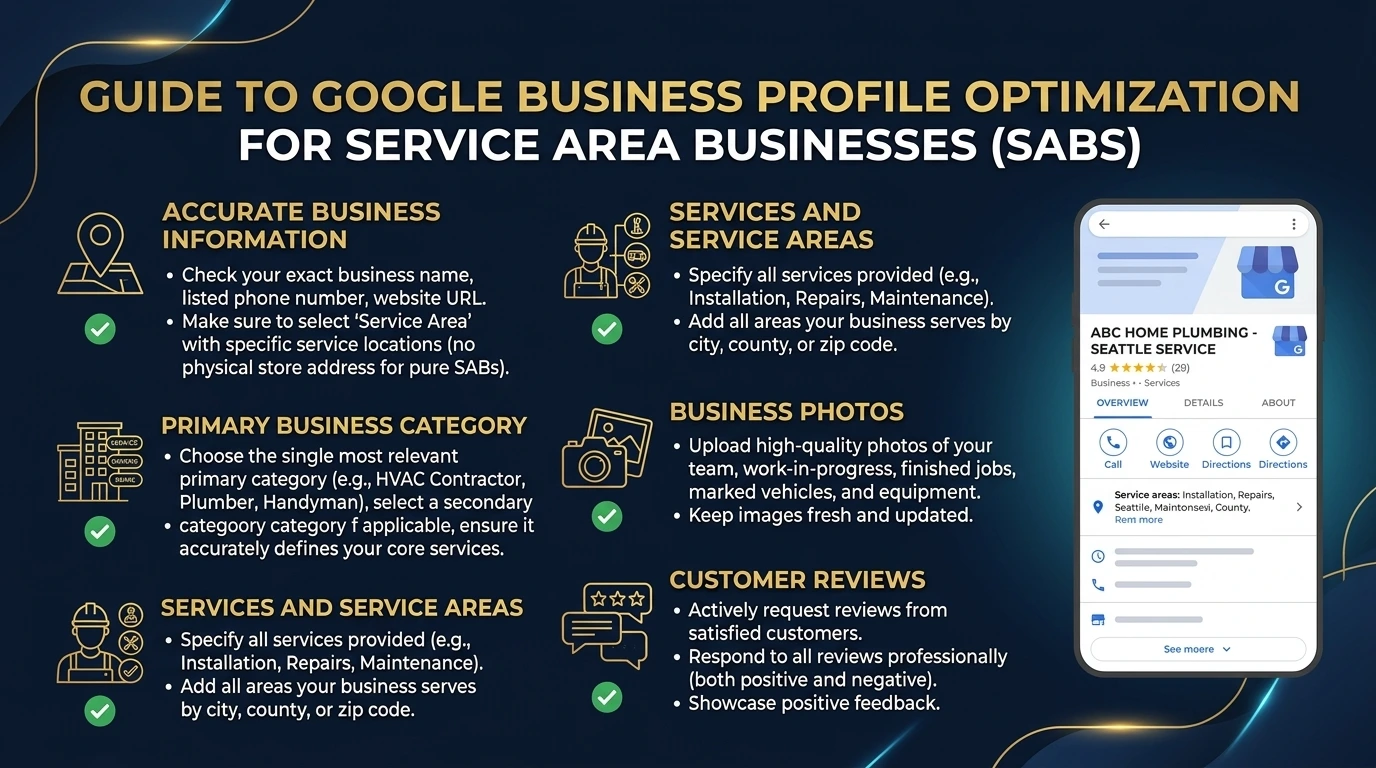
Google Business Profile is an important starting point for many eligible local service businesses.
Before making changes, check whether your business meets Google's eligibility requirements and follow its guidelines.
Choose an Accurate Primary Category
Your primary category should describe the main type of business you operate.
For example:
A plumbing company should select an appropriate plumbing category.
An HVAC contractor should select a relevant heating or air-conditioning category.
A cleaning company should choose a category that accurately represents its cleaning business.
Add secondary categories only when they genuinely describe additional business activities. Do not use categories simply to insert more keywords.
Write a Clear Business Description
Explain your main services, the customers you help, and the areas you serve.
For example:
"We provide residential plumbing services in Dallas, Texas, including leak repairs, drain cleaning, fixture installation, and general plumbing maintenance."
This is an illustrative description. A real business should mention only the services it actually offers.
Add Relevant Services and Photos
List your genuine services and provide clear descriptions. Upload authentic photos of your team, equipment, vehicles, and completed work where appropriate.
Keep Business Information Updated
Review:
Business name
Primary and secondary categories
Phone number
Website
Operating hours
Services
Business description
Service-area information
Use your real-world business name. Adding extra location or service keywords to the business name when they are not part of the actual name can violate Google's guidelines.
Google recommends accurate business information and appropriate categories to help its systems understand and match businesses with relevant searches.
3. Choose the Right Service Areas
Selecting realistic service areas is an important part of service area business SEO.
Your service-area information should reflect the places where your business genuinely provides services.
For example, a Dallas plumbing company might serve Dallas and selected nearby communities if its technicians regularly travel there to complete customer jobs.
Before adding a location, ask:
Do we actually provide services in this area?
Can our team travel there to complete jobs?
Is this location part of our normal operating area?
Can we provide accurate information about the services available there?
Avoid adding every nearby city simply to target more searches.
Should You Hide Your Business Address?
If customers do not visit your business location and your business qualifies as a service-area business under Google's guidelines, you should hide the address displayed on your Business Profile and specify the areas you serve.
For example, a plumber who operates from a residential address and travels to customers should generally hide that residential address from customers.
A virtual office or rented mailing address where the business does not actually operate is not a valid substitute for an eligible business location.
Google also has specific rules for hybrid businesses that serve customers both at a staffed storefront and at customer locations.
Read the official guidelines before changing your profile:
Remember: adding more service areas does not automatically make your business rank across every listed city. Search results can vary depending on the searcher's location and other local ranking factors.
4. Create Helpful Service and Location Pages
Your website should make it easy for visitors to understand what you offer and where you operate.
A service-area business may benefit from separate pages for its main services.
For example, an HVAC company could have:
Air Conditioning Repair
HVAC Installation
Heating Repair
Preventive HVAC Maintenance
Each page should explain the service clearly and answer common customer questions.
When Should You Create Location Pages?
If your company genuinely serves multiple communities, useful location-specific pages may help customers understand your coverage.
For example, a Dallas plumbing company could create a page about plumbing services in a nearby community if it has genuine service coverage and useful information to share about that area.
A helpful location page might include:
A clear explanation of the services available.
The actual area covered.
Details about common customer problems.
Relevant information about how the service works.
Genuine project or team photos, where available.
Contact information and a clear way to request service.
Do not create dozens of pages that contain almost identical text with only city names changed. Each page should provide a distinct reason for a visitor to read it.
The goal is not simply to publish more pages. It is to create useful information for real customers.
5. Find the Right Local SEO Keywords
Keyword research helps you understand how potential customers search for your services.
A customer looking for a plumber may use different search terms depending on the problem, urgency, and location.
For example:
Service | Example search phrase |
Plumbing | Plumber in Dallas |
Emergency plumbing | Emergency plumber in Houston |
HVAC | HVAC repair in Phoenix |
Air conditioning | AC repair in Austin |
Cleaning | House cleaning service in Chicago |
Electrical | Electrician in San Diego |
These are examples of search phrases, not verified search-volume claims.
A Practical Local Keyword Research Process
Step 1: List your services.
Write down the main services your business provides. Separate different services when they have different customer needs.
Step 2: Identify genuine service locations.
List the cities and communities where your team actually works.
Step 3: Research search phrases.
Use keyword research tools to find relevant service-related and location-related searches.
Step 4: Understand search intent.
A person searching for "how to fix a leaking faucet" may want information, while someone searching for "emergency plumber in Dallas" may be looking to hire a professional.
Step 5: Organize keywords by page.
Assign relevant keywords to the most appropriate service page or location page.
Step 6: Write naturally.
Use the main phrase in a relevant title or heading when appropriate. Include related terms where they genuinely help explain the service.
Avoid keyword stuffing. A page should read naturally and answer the visitor's question.
6. Follow Local SEO Best Practices
Improving local SEO requires more than updating a Google Business Profile. Your website and other online business information should support the same accurate description of your services.
Maintain Consistent NAP Information
NAP stands for:
Name
Address
Phone number
Review your website and relevant business listings to identify outdated phone numbers, incorrect addresses, inconsistent business names, and duplicate entries.
For a service-area business that hides its residential address on Google, do not publish that private address simply to create matching directory listings. Follow each platform's eligibility and address-display requirements.
Build Relevant Local Citations
A local citation is an online mention of a business's details. It may appear in a business directory, an industry-specific website, or a local business resource.
A practical citation process includes:
Reviewing existing business listings.
Identifying outdated or incorrect information.
Finding duplicate entries.
Selecting relevant and legitimate directories.
Updating or submitting accurate information where eligible.
Checking publication status and recording pending corrections.
A business does not need to appear in every directory. Relevance, accuracy, and eligibility matter more than the number of submissions.
Improve Website Quality
Review the following areas:
Mobile usability
Page loading performance
Clear website navigation
Descriptive page titles
Useful service information
Working internal links
Indexing and crawlability
Appropriate structured data where relevant
These improvements help create a better experience for website visitors and make important business information easier for search engines to understand.
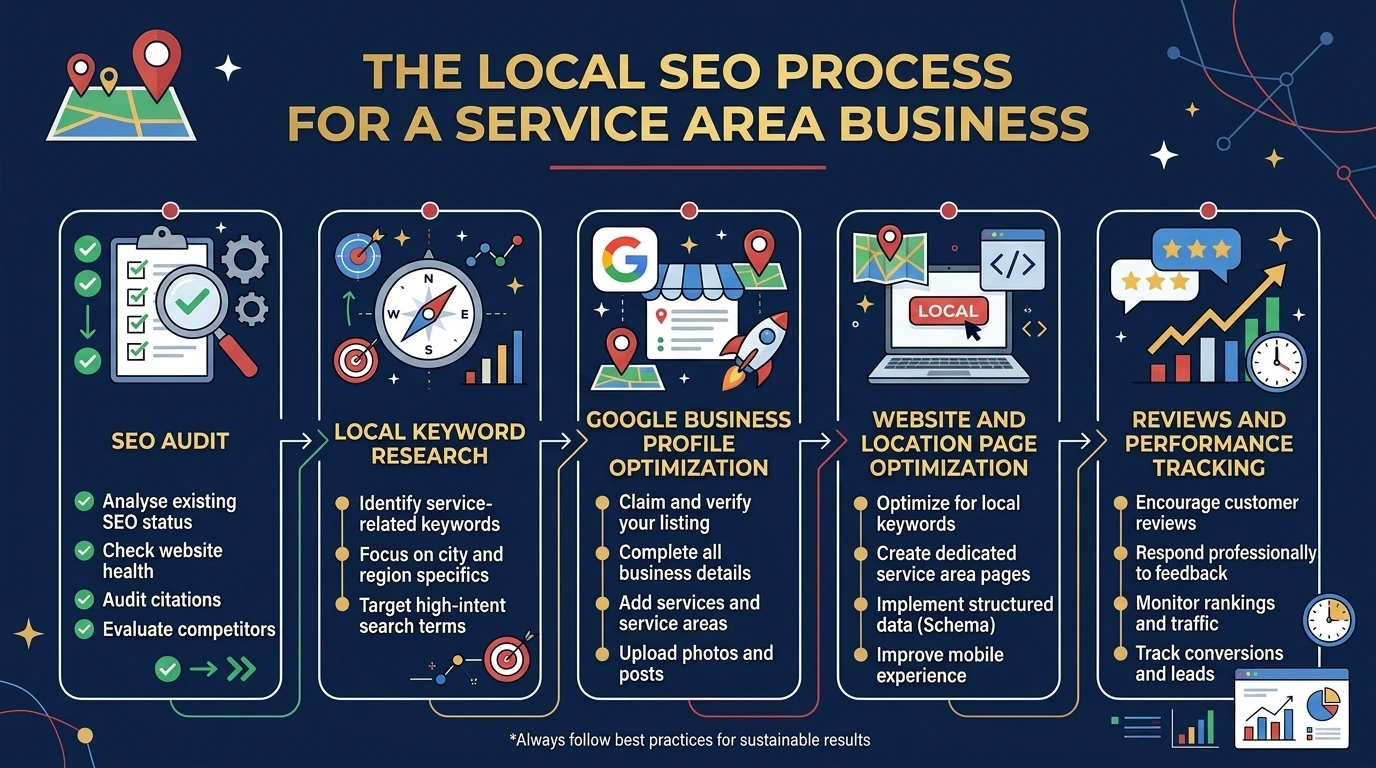
7. Get and Manage Genuine Customer Reviews
Customer reviews can help potential customers evaluate a business before requesting a service.
For home-service companies, reviews may describe the customer's experience with scheduling, communication, workmanship, and service quality.
How to Request Reviews
After completing a genuine customer job:
Thank the customer for choosing your business.
Send a polite review request.
Provide a convenient way to leave feedback.
Allow the customer to express an honest opinion.
Avoid offering prohibited incentives or purchasing reviews.
How to Respond to Reviews
Respond professionally to both positive and negative feedback.
For a positive review:
"Thank you for taking the time to share your experience. We appreciate your feedback and are glad we could help with your plumbing service."
For a negative review:
"Thank you for sharing your feedback. We are sorry to hear that your experience did not meet expectations. Please contact our team so we can better understand the situation and discuss the next steps."
These are sample responses. Adapt them to the customer's actual experience and never disclose private customer information.
Reviews are useful for reputation management and can contribute to local prominence. However, a particular number of reviews does not guarantee a specific search position.
Google recommends managing customer reviews and keeping Business Profile information up to date as part of improving local visibility.
8. Understand Google Local Pack and Local Search Rankings
When someone searches for a local service, Google may display a map and a group of business listings. This is commonly called the Google Local Pack.
For example, a customer in Dallas might search for "plumber near me" and see local businesses in Google Search or Maps.
Google explains that local results are primarily influenced by three factors:
Relevance
Relevance describes how well a business matches what the customer is searching for.
Accurate business categories, services, and detailed business information can help Google understand the business.
Distance
Distance refers to how far a business is from the searcher or the location mentioned in the search.
A company may appear in different positions depending on where the customer searches from.
Prominence
Prominence describes how well-known a business is. Google may consider information from across the web, including links and customer reviews.
These factors help explain why one service-area business may appear prominently in one neighborhood but less visibly in another.
For example, a Dallas HVAC company may have a stronger local presence near its operating base than in a community much farther away.
There is no reliable way to guarantee the same local search position across an entire city or region. Google also states that businesses cannot request or pay for a better local ranking.
9. Track and Improve Local Search Performance
Local SEO should be reviewed regularly. Instead of checking only one keyword, monitor several aspects of your online presence.
Google Business Profile Performance
Where available, review profile performance information such as:
How customers discover your profile
Search terms associated with your profile
Website clicks
Calls
Other available customer interactions
Google Search Console
Google Search Console helps website owners understand how their pages perform in Google Search.
Useful information includes:
Search queries
Impressions
Clicks
Click-through rate
Average position
Page indexing information
Review relevant pages and queries to identify opportunities for improvement.
Website Analytics
Where analytics is installed and configured correctly, review useful website activity such as:
Visits to important service pages
Contact form submissions
Phone or contact button interactions
Traffic sources
Engagement with key pages
Use these measurements to understand whether your website is helping visitors take meaningful actions.
A Simple Monthly Local SEO Review
Task | What to check |
Google Business Profile | Accuracy and completeness |
Website | Important service pages and technical issues |
Keywords | Relevant search queries and trends |
Citations | Incorrect and duplicate listings |
Reviews | New feedback and owner responses |
Performance | Search visibility and customer actions |
Do not treat a change in one keyword's position as proof that the entire local SEO strategy is succeeding or failing. Review performance across relevant searches, locations, and customer actions.
10. Avoid Common Service Area SEO Mistakes
Some common shortcuts can create problems for a service-area business.
Adding Locations You Do Not Serve
Only list areas where your business genuinely operates. Adding unrelated locations can mislead customers.
Using an Ineligible Business Address
Do not use a virtual office or a mailing address where the business does not operate as a substitute for an eligible business location.
Keyword Stuffing the Business Name
Use your real-world business name. Do not add extra services or city names just to influence search results.
Publishing Duplicate Location Pages
Changing only a city name across many pages does not create useful local content. Give each page meaningful, location-relevant information.
Buying or Creating Fake Reviews
Reviews should come from real customers sharing genuine experiences. Avoid purchased reviews, fake accounts, and prohibited incentives.
Submitting to Irrelevant Directories
Focus on relevant, legitimate platforms. A large number of low-quality submissions is not a substitute for accurate business information.
Expecting Guaranteed Rankings
No SEO provider can guarantee a particular Google position. Local search results depend on multiple factors, including relevance, distance, prominence, and competition.
How Local SEO Pro Can Help Service Area Businesses
At Local SEO Pro, we help businesses improve their local online presence through practical SEO services.
Depending on the agreed service, our work may include:
Google Business Profile optimization
Local SEO audits
Local keyword research
Google Maps optimization
Local citation building and NAP consistency
Website and service page optimization
Review management support
Local SEO reporting and performance tracking
We review your business information, website, and local search presence to identify areas that may benefit from improvement.
Our approach focuses on accurate information, useful content, and practical recommendations based on the business's actual needs. We do not promise guaranteed rankings or instant results.
If you operate a service-area business in the United States and want to strengthen your local online presence, explore our services.
Explore Local SEO Pro Services:
Contact Local SEO Pro:
Frequently Asked Questions
1. How do I rank a service area business on Google?
Start with an eligible and accurate Google Business Profile, realistic service areas, useful website pages, relevant local keywords, genuine customer reviews, and accurate business listings. Review your performance regularly and improve areas where you find genuine issues.
2. Can a service-area business rank on Google Maps without showing its address?
Eligible service-area businesses that travel to customers and do not receive customers at their business location should hide their address on Google Business Profile. Hiding the address does not guarantee a particular Google Maps ranking.
3. How many service areas should I add to Google Business Profile?
Choose areas that accurately represent where your business provides services. Do not add cities simply to target more keywords. Follow Google's service-area guidelines and keep your coverage realistic.
4. Does a service-area business need a website?
A website is not always required to create an eligible Google Business Profile. However, a useful website can explain your services, show your coverage, answer customer questions, and provide contact options.
5. What is the Google Local Pack?
The Google Local Pack is a group of local business results that may appear with a map in Google Search. Its results are influenced primarily by relevance, distance, and prominence.
6. How can I improve local SEO for my home-service business?
Start by improving your Google Business Profile, creating useful service pages, researching relevant local keywords, maintaining accurate business listings, encouraging genuine customer reviews, and monitoring website performance.
7. How long does local SEO take to show results?
There is no fixed timeline. Results depend on your website, competition, location, profile condition, and the improvements made. Some technical or content changes may be noticed sooner, while broader visibility improvements can take longer.
8. Do more Google reviews guarantee higher rankings?
No. Genuine reviews can contribute to reputation and prominence, but review count alone does not guarantee a particular ranking.
9. Can I rank in every city listed in my service areas?
Not necessarily. Listing a service area does not guarantee visibility throughout that area. Local results vary based on factors such as the searcher's location, relevance, and prominence.
10. What are the most important local SEO best practices?
Maintain accurate business information, choose appropriate categories, create useful website content, build relevant citations, manage genuine customer reviews, follow Google guidelines, and review performance regularly.
Final Thoughts
Learning how to rank a service area business on Google starts with understanding how customers search for local services and making it easy for them to find accurate business information.
Build an eligible Google Business Profile, select realistic service areas, create helpful service pages, research relevant keywords, maintain accurate business listings, and manage genuine customer feedback.
Most importantly, remember that local search rankings can vary by location and search query. Focus on building a trustworthy online presence and improving the customer experience rather than chasing guaranteed positions.
Local SEO Pro — Practical Local SEO Support for Service Area Business